
Electrical Safety Audit
An independent audit of panels, wiring and earthing as per the CEA (MSES) Regulations, 2023, by the same in-house engineer.
Learn moreFire Safety
An independent audit of your building's fire protection systems, escape routes and emergency readiness, with every gap listed in priority order. In Maharashtra this audit is mandatory for certain buildings, and only a licensed auditor may conduct it.
The licence
Under the Maharashtra Fire Prevention & Life Safety Measures Act, only a Licensed Fire & Life Safety Auditor authorised by the Directorate of Maharashtra Fire & Emergency Services may conduct the fire and life safety audit the law mandates. So before you compare quotes, ask every bidder for one thing: the licence number.
PowerTech holds licence MF&ES/F&LSA/0029, valid to 21 September 2027. Below are the credentials behind every PowerTech fire safety audit:
Authorised by
Directorate of Maharashtra Fire & Emergency Services
Licence MF&ES/F&LSA/0029 · Valid to 21 Sep 2027
Accredited by
Fire & Security Association of India
Valid to 26 Feb 2027
Authorised by
Govt. of Maharashtra
Under the CEA (MSES) Regulations, 2023
Awarded by
Maharashtra State Board of Technical Education
First Class
Licence on record
The licence opens full-size in a new tab.
The mandate
In Maharashtra, for certain buildings, yes. The Maharashtra Fire Prevention & Life Safety Measures Act, 2006 (Amendment 2023) makes a fire and life safety audit mandatory for specific building types. Below is how the mandate works:
The mandate covers buildings above 30 metres in height used as hotels, hospitals, business or IT offices, malls and commercial complexes, or mixed-occupancy buildings.
Responsibility for getting the audit done sits with the building owner. If the owner is not available, it passes to the occupier or the management.
For mandated buildings, the first audit fell due within one year from March 2023. After that, the audit repeats once every two years.
Outside these categories the Act's audit mandate does not apply. Factories, warehouses and buildings in other states generally book the same audit to find gaps before an incident, an insurer or a fire NOC renewal does.
The audit
A fire safety audit is a detailed inspection of a facility's fire protection systems, life safety arrangements and emergency preparedness. Auditors walk the site, check what is actually installed and working, and compare its condition against what the law and applicable fire safety codes require.
Many buildings got their fire systems at construction and have never had them independently assessed since. Extinguishers pass their service dates. Sprinkler and detection systems sit untested.
Escape routes fill up with storage. Mock drills quietly stop. These gaps stay invisible until an incident, an inspection or a fire NOC renewal brings them up.
PowerTech conducts fire and life safety audits from Pune, with a presence in Mumbai and Nashik and audits delivered across India. The firm is a Licensed Fire & Life Safety Auditor, and the audit stays independent: we advise, we never sell you equipment.
Below is what every audit checks at minimum:
What we audit
The scope is agreed before the visit, so you know exactly what gets checked. Below are the systems our auditors physically inspect on site:
Fire pumps, the hydrant network and hose reels checked physically for condition and readiness, so water reaches a fire when it must.
Sprinkler coverage and condition verified area by area, so protection matches the fire load beneath it.
Detectors, call points and panels tested for function, so a fire is announced while it is still small.
Types, placement, service dates and access checked against the areas each unit protects.
Exit widths, travel paths, door condition and signage walked end to end, with every obstruction recorded.
Checked floor by floor, so people can still find the way out in smoke or a power failure.
Fire barriers, shaft sealing and the command centre reviewed where the building has them, so smoke and fire stay contained.
Wiring, panels and the substation reviewed for fire risk by the in-house Chartered Electrical Safety Engineer.
The process
The same methodology runs on every site, scaled to its size and fire load:
A kick-off with your safety and facilities heads, then a data checklist: fire NOC, building drawings, fire system layouts, past inspection reports and applicable compliance records.
The collected data becomes a site-specific audit protocol before anyone reaches your gate, covering the full agreed scope.
Auditors walk the facility with instruments and checklists. Fire protection systems, life safety arrangements and emergency management are physically checked, and observations recorded.
Everything observed lands in one report: the status of each system, gaps cited against the applicable code clause, and corrective actions in priority order.
Fix the findings with your own contractors, or hand the corrective work to PowerTech, turnkey or as consultants.
The paperwork
Every audit ends in a document trail your management and the authorities can act on. Below is what you hold when the audit closes:
The as-found status of every system inspected, each gap and non-compliance, and corrective actions in priority order.
Observations cite the applicable code clause
For mandated Maharashtra buildings, the Licensed Auditor issues the Certificate of Compliance and submits it to the Director of Maharashtra Fire Services, the Chief Fire Officer or the Nominated Officer.
Issued under the Maharashtra Fire Act mandate
The report drives the corrective phase, handled in-house or with our support. If you are floating a tender, we quote against your scope of work too.
The auditor
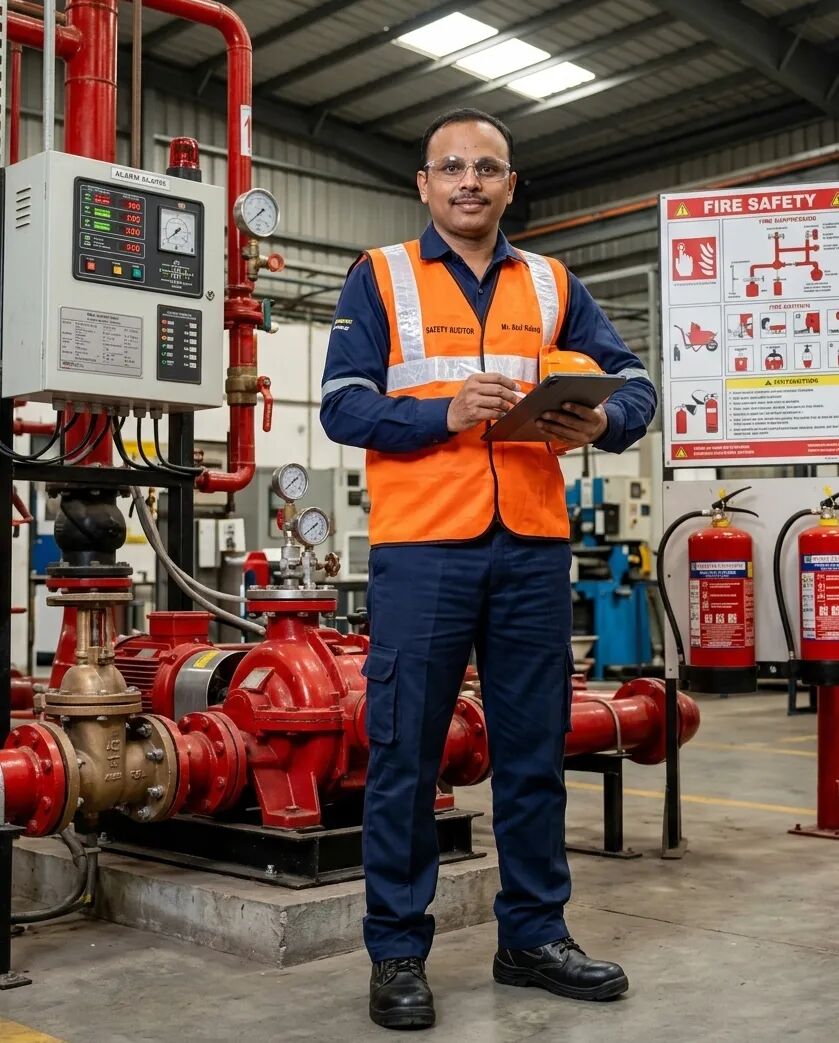
A licence is held by a firm. An audit is conducted by a person. PowerTech's fire and life safety audits run under Atul Kakad, the qualified auditor on the firm's F&LSA licence. The same auditor is a Chartered Electrical Safety Engineer, so the electrical side of fire risk gets a specialist's eye.
Qualified auditor, F&LSA licence
PowerTech licence MF&ES/F&LSA/0029
FSAI Accredited Professional
Valid to 26 Feb 2027
Chartered Electrical Safety Engineer
Authorised under the CEA (MSES) Regulations, 2023
Advance Diploma in Industrial Safety
First Class
Buildings we audit
Fire load and occupancy decide what an audit emphasises. Below are the facilities we audit:
High fire load from materials, chemicals and continuous operations. Audits cover protection systems, hazardous areas and emergency management.
Request an auditThe mandated category in Maharashtra: hotels, hospitals, offices, malls and mixed use. Audit first, then the Certificate of Compliance.
Request an auditSleeping guests and busy kitchens raise the stakes. Escape routes, kitchen fire points and staff readiness get extra attention.
Request an auditOccupants who cannot evacuate on their own. Detection, compartmentation and evacuation planning carry the audit's weight here.
Request an auditLarge occupant loads and public access make fire NOC compliance critical. Common systems and tenant floors are both covered.
Request an auditCommon areas first: extinguishers, common wiring, emergency lighting and escape routes, in a report the committee can act on.
Request an auditAlso from PowerTech
Audits that pair naturally with fire safety:
An independent audit of panels, wiring and earthing as per the CEA (MSES) Regulations, 2023, by the same in-house engineer.
Learn moreMap how your facility uses energy and get a costed, payback-ranked savings plan.
Learn moreA practical, costed plan to cut consumption and hit your conservation targets.
Learn moreStraight answers to what building owners and safety heads usually ask:
Book the audit
Start with the basics: building type, height, use and city. Mandate, fire NOC renewal, insurer's requirement or a near-miss, whatever brought you here, the team scopes the audit and returns commercial terms.
No obligation, just a conversation about your building.